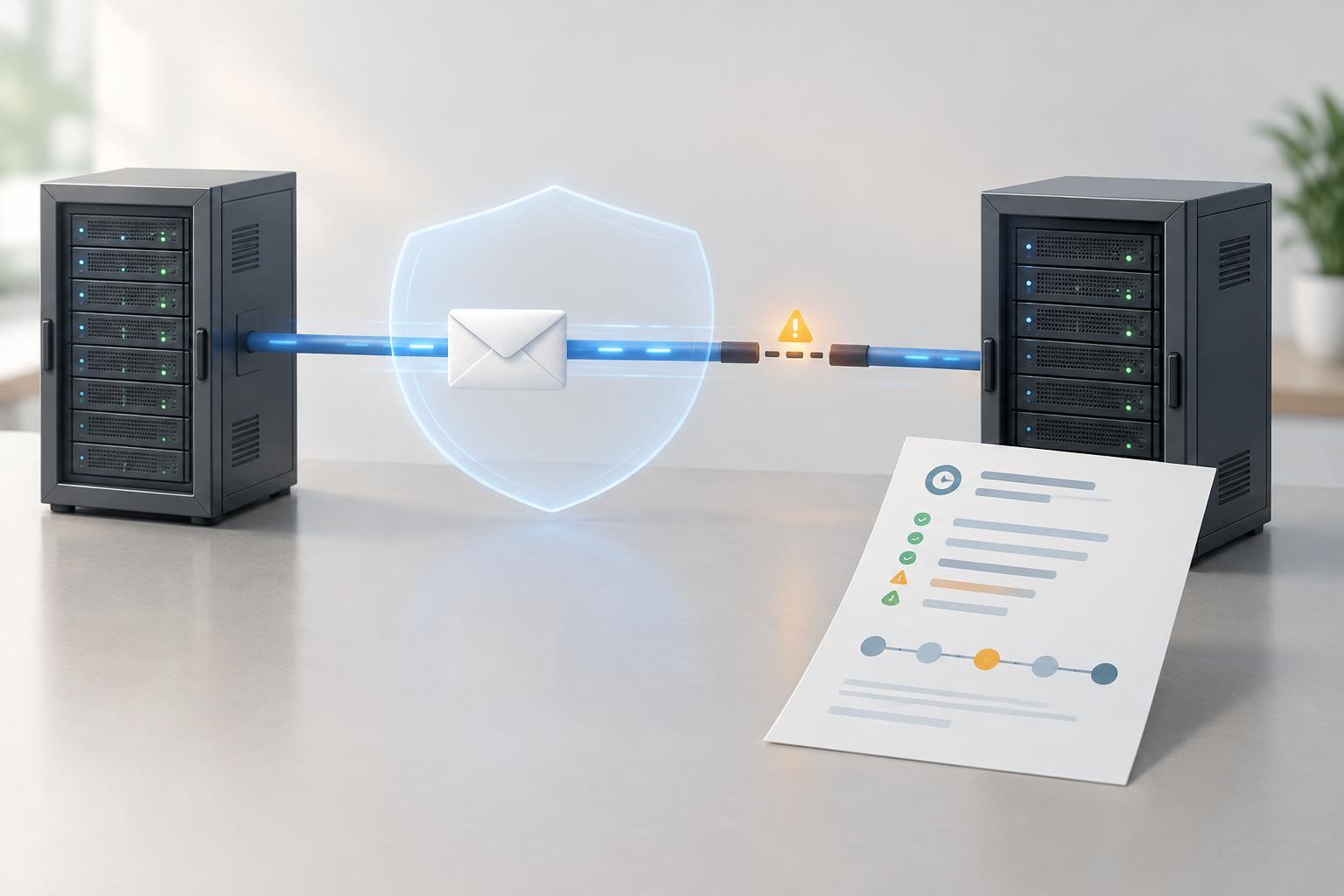
Why encrypted mail delivery can fail
When one mail server sends a message to another, the servers may use TLS to protect the connection between them. The sending server must first find the receiving domain’s mail servers through DNS. It then connects to one of those servers and may negotiate TLS using STARTTLS. Problems at any of these stages can interfere with encrypted delivery: a server might not offer STARTTLS, a TLS handshake might fail, or a certificate might not pass the checks the sender requires.
The result depends on the sender’s requirements. Some senders may try delivery without TLS when encryption is unavailable. If a sender is applying a policy that requires a valid encrypted connection, it may instead defer delivery or eventually give up. From the receiving domain’s perspective, these problems can be hard to notice: a message that never arrives does not appear in the recipient’s inbox. SMTP TLS reporting, often called TLS-RPT, provides a way to hear about certain failures observed by participating senders.
What the TLS reporting DNS record does
A receiving domain publishes its TLS-RPT setting as a DNS TXT record at _smtp._tls followed by its domain name. For a domain such as example.com, the record would be placed at _smtp._tls.example.com. A simple example value is “v=TLSRPTv1; rua=mailto:tls-reports@example.com”. The version identifies the record as a TLS-RPT record, and the rua address tells senders where to send aggregate reports.
The record does not turn on TLS, repair a certificate, or require every sender to encrypt mail. Its role is to request reports from senders that support TLS-RPT. It is also distinct from an MTA-STS policy or DNS-based TLS authentication: those mechanisms can tell senders what secure delivery should look like, while TLS-RPT helps a domain owner see problems senders encountered. Publishing a reporting record without reviewing the reports provides little operational benefit.
What a report can reveal
TLS-RPT reports summarize delivery attempts over a reporting period rather than describing every message individually. They can identify the receiving domain, the policy a sender applied, counts of successful and failed connection attempts, and categories of failure. Depending on the sender and the problem, details may point to an unavailable STARTTLS option, a TLS negotiation error, a certificate validation problem, or a mail server that did not match an expected policy.
Those distinctions help narrow an investigation. If failures cluster around one receiving mail server, compare that server’s TLS and certificate configuration with the others. If reports indicate a mismatch with a published policy, check whether the policy still describes the servers currently handling the domain’s mail. If several senders report a similar problem, that pattern may be more useful than a single isolated failure.
Reports are not a complete delivery log. Only participating senders provide them, and their observations may differ. A report cannot prove that every message arrived, that every connection was private, or that a particular person sent a particular message. It does not contain message bodies. Treat its counts and failure descriptions as diagnostic clues, not as a full inventory of the domain’s email traffic.
A practical way to use the findings
Before publishing a TLS-RPT record, choose a reporting mailbox or service that can receive and process the reports. Reports may be machine-readable attachments and can be awkward to inspect manually. Keep access to them limited to people responsible for mail operations: although they do not contain message content, they may reveal mail server names, addresses, and configuration details.
Once reports arrive, start by grouping failures by receiving server and failure type. Check the domain’s MX records, the servers they name, whether those servers offer STARTTLS, and whether their certificates and any published mail-security policy agree with the intended setup. Make one configuration change at a time where practical, then watch subsequent reports for a change in the pattern. Some failures originate outside your systems, so a report is a reason to investigate, not automatic proof that your server is misconfigured.
TLS-RPT is most useful as an early-warning and troubleshooting aid. It gives domain owners a view of secure-delivery problems that might otherwise remain invisible, while leaving the actual work—maintaining mail servers, certificates, DNS records, and policies—to the people operating those systems.


